How Do Beat Leases Work? Stream Limits & Rights Guide
For decades, getting access to industry-grade production required either signing your life away to a major record label or paying thousands of dollars up front for exclusive studio sessions. Online beat marketplaces revolutionized the independent music industry by introducing beat leasing—a model that lets you license platinum-level instrumentals for $30 to $150. Yet, many recording artists still hesitate at checkout because the legal jargon feels confusing. What happens when your song hits its stream limit? Who owns the master recording on Spotify? Can another artist use the same beat? Understanding how do beat leases work removes the guesswork, protects your hard-earned royalties, and ensures you choose the exact licensing tier your release needs.
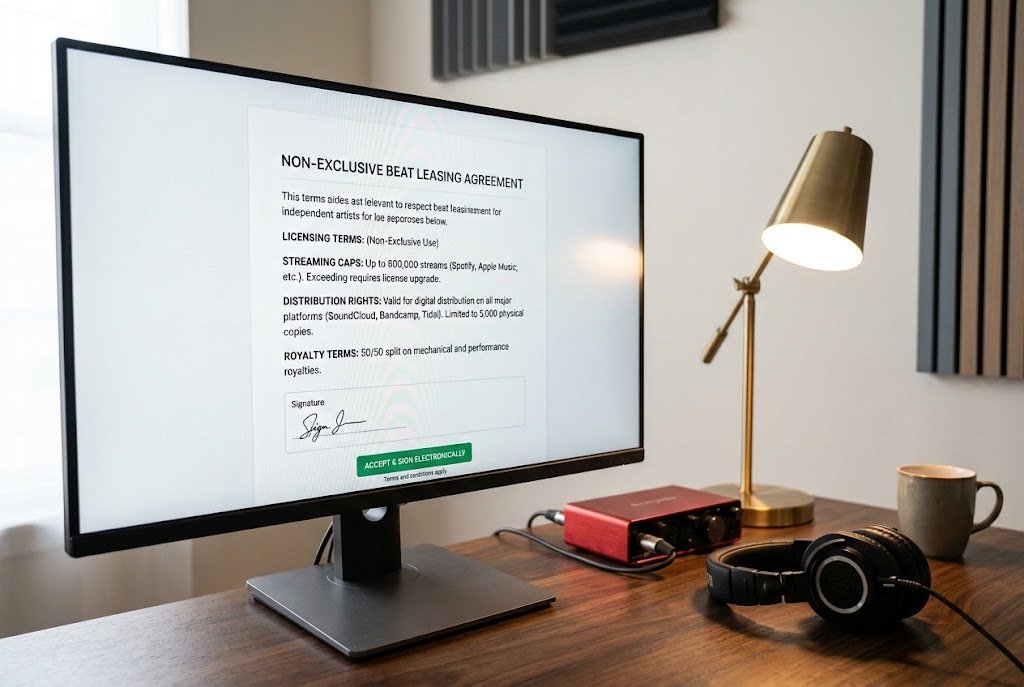
How Do Beat Leases Work? The Complete Guide to Stream Limits & Rights
The modern independent music landscape runs on beat leasing. From bedroom recording artists to Billboard-charting rappers, leasing instrumentals online has replaced the outdated model of spending thousands of dollars for exclusive studio time with top-tier producers.
Yet, despite its widespread adoption, beat leasing remains one of the most misunderstood legal transactions in the music business.
Artists constantly ask: Do I own the song once I buy a lease? Can the producer take my track down if it blows up? What happens if I go over the stream limit?
Understanding how do beat leases work comes down to recognizing the fundamental difference between purchasing a physical product and licensing intellectual property.
When you grasp the mechanics of non-exclusive rights, distribution caps, and publishing splits, you can release music with total legal confidence while keeping your overhead costs low.
What Is a Beat Lease? (The Apartment Rental Analogy)
At its core, a beat lease is a non-exclusive license.
When a producer creates an instrumental, they own two distinct copyrights: the Sound Recording (the Master) and the underlying Musical Work (the Composition).
When you purchase a lease, the producer does not sell you ownership of the music. Instead, they grant you a time-limited or volume-limited legal permission to record your vocals over their instrumental and commercially exploit that new derivative song across streaming platforms, digital stores, and social media.
[THE REAL ESTATE ANALOGY OF BEAT LICENSING]
 ├── Exclusive Rights = BUYING THE HOUSE
 │    └── You own the property outright. Nobody else can move in or buy it.
 └── Beat Lease (Non-Exclusive) = RENTING AN APARTMENT
      └── Multiple tenants can rent identical units in the same building.
          You have full legal right to live there and enjoy it,
          subject to the rules laid out in your lease agreement.
Because the license is non-exclusive, the producer retains the legal right to license that exact same instrumental to other artists. Multiple rappers and singers can release songs over the identical beat simultaneously—and every single one of those releases is 100% legal.
1. Stream Limits and Distribution Caps Explained
The primary variable that separates a $30 lease from a $150 lease is the distribution threshold.
Every non-exclusive contract includes explicit usage caps. These limits define how far your song can travel commercially before you are required to upgrade your license or negotiate an exclusive buyout.
The Most Common Lease Caps:
Audio Streams: The total number of interactive on-demand plays allowed across platforms like Spotify, Apple Music, Tidal, and Amazon Music (e.g., 50,000 streams on a basic lease vs. 500,000 streams on a premium tier).
Music Video Views: The total allowed monetized views across YouTube, Vevo, and Vimeo.
Physical Sales: The maximum number of physical units (CDs, vinyl, cassette tapes, or USB drives) you can press and sell.
Paid Performances & Radio Plays: The number of terrestrial or satellite radio spins permitted, along with earnings limits on live shows where the track is performed.
[WHAT HAPPENS WHEN YOU HIT A STREAM CAP?]
 Your single hits 100,000 streams (License cap reached)
       │
       ▼
 The legal authorization granted by your contract EXPIRES
       │
       ├── OPTION A: Upgrade to a higher tier lease (e.g., WAV or Trackout tier)
       ├── OPTION B: Purchase Exclusive Rights (if still available)
       └── FAILURE TO ACT: Continued streaming becomes unlicensed copyright infringement
Hitting your stream limit is not a penalty—it is proof of concept. It means your song generated traction.
Once you approach the cap, you simply contact the producer or return to their store to purchase the next tier up, applying your initial investment toward the upgrade.
2. Who Owns What? Master vs. Composition Splits
One of the biggest misconceptions among independent artists is that buying a beat gives them 100% ownership of the finished track.
In the music business, every recorded song consists of two separate entities:
A. The Master Recording (The Derivative Work)
You own your specific vocal performance and the finalized master recording of that release, subject to the limitations of your lease agreement. The producer cannot take your recorded vocals and sell them to another artist.
B. The Underlying Publishing (The Composition)
Under standard industry agreements (including BeatStars, Airbit, and major producer contracts), the composition is split down the middle:
50% Writer’s Share to You (The Artist): For your original lyrics, vocal melodies, and cadence arrangement.
50% Writer’s Share to the Producer: For creating the instrumental composition, chord progressions, and melodic foundations.
This 50/50 publishing framework applies whether you lease an instrumental for $30 or purchase exclusive rights for $2,000. When registering your song with PROs (ASCAP/BMI) or mechanical agencies (The MLC), you must credit the producer accordingly.
Learn how to ensure all compositional revenue is captured in our complete breakdown of Mechanical Royalties Explained: How The MLC Pays Independent Songwriters.
3. The 3 Standard Beat Lease Tiers Compared
Producers typically structure their catalogs into three or four clear pricing tiers based on audio file format and commercial allowances.
| License Tier | Typical Price | Included Audio Files | Average Stream Limit | Commercial Terms & Use Case |
| Standard Lease (MP3) | $25 – $40 | Compressed MP3 (320 kbps) | 10,000 – 50,000 | Rough demos, SoundCloud releases, preliminary writing sessions. |
| Premium Lease (WAV) | $45 – $75 | 24-bit Lossless WAV + MP3 | 100,000 – 250,000 | Official Spotify/Apple Music commercial singles, official music videos. |
| Trackout Lease (Stems) | $100 – $200 | Individual WAV Stems + Master WAV | 500,000 – 1,000,000+ | High-budget singles, radio campaigns, professional studio mixing. |
| Unlimited Lease | $200 – $350 | Full Stems + WAV + MP3 | Unlimited Streams | Major independent pushes with no risk of stream expiration. |
Choosing the right format directly affects your final audio quality.
A compressed MP3 file introduces digital artifacts and lacks dynamic headroom when mixed against raw vocals. To understand the acoustic differences before buying, read our technical evaluation on MP3 vs WAV Spotify: Which Beat License Do You Actually Need?.
4. What Happens If Someone Buys the “Exclusive Rights” Later?
This is the number one source of anxiety for independent creators: If I buy a $50 lease today, and a major label artist buys the exclusive rights next month, will my song be taken down?
The answer is no, thanks to the Grandfather Clause.
Every legally enforceable beat lease contains a clause stating that previously sold non-exclusive licenses remain valid until their agreed terms (stream caps or contract duration) expire naturally.
[THE EXCLUSIVE BUYOUT TIMELINE]
 January 1 : You lease Beat X (Limit: 100,000 streams)
 February 1: Artist Y buys Exclusive Rights to Beat X for $2,500
 RESULT    : Beat X is removed from the store for future buyers.
             Artist Y owns the exclusive master going forward.
             YOUR LEASE REMAINS 100% VALID until you cross 100,000 streams.
The buyer of the exclusive rights cannot retroactively terminate your contract, sue you for copyright infringement, or force your song off streaming platforms, provided you remain within your original stream allowances.
However, once you hit that 100,000 stream ceiling, you cannot renew the lease, because the rights have been exclusively assigned to someone else.
5. Beat Leases and the YouTube Content ID Trap
If there is one technical rule every recording artist must memorize, it is this: You can almost never enroll a leased beat into YouTube Content ID or distributor monetization engines.
Because a leased beat is non-exclusive, hundreds of creators have legal access to the exact same audio bed.
If you check the “YouTube Content ID” or “YouTube Money” box on DistroKid or TuneCore, you instruct YouTube to scan the entire internet for matching audio. The system will then place automated copyright claims on everyone else who leased the beat—including the producer’s own channel.
This is a direct violation of YouTube’s platform policies and your lease agreement.
If your music video was claimed by another creator who leased the same instrumental, follow our step-by-step resolution guide in YouTube Content ID Dispute Leased Beat: How to Clear Fraudulent Claims.
Why Multitrack Stems Are the Smartest Investment
If you plan to promote your song with advertising, shoot a high-end music video, or pitch for editorial playlists, buying a basic stereo two-track file is a creative bottleneck.
When you purchase an MP3 or standard WAV lease, all instruments—the 808, kick, snares, synths, and melodies—are baked into one unalterable stereo audio file.
If the beat’s main synthesizer clashes with your vocal range, your mix engineer cannot turn down the synth; they have to compromise your entire vocal presence to make it fit.
By investing in a Trackout / Stems Lease, you receive isolated audio tracks for every single element. Your engineer can:
Carve out precise frequency pockets so your lead vocal commands the center stage.
Mute distracting melodies during the verses to highlight your lyrical storytelling.
Extend or rearrange the intro, bridge, and chorus drops to build tension.
Discover how stem files transform your studio mixes in our guide on What Are Beat Stems? Why Trackout Files Are Essential for Artists.
Transparent Licensing with Zero Hidden Traps
The key to a long-lasting career in music is building relationships with producers who respect your business and provide clear, straightforward legal protection.
At Prod By DSG, our licensing structure is built around total transparency.
Every instrumental in our store includes clearly defined streaming allowances, unambiguous 50/50 publishing terms, and zero hidden penalties. When you license from our catalog, you receive high-headroom 24-bit uncompressed WAV files and complete multitrack stems, paired with instant PDF contract delivery.
Whether you need a dynamic Florida bounce rhythm, an introspective melodic trap pocket, or a smooth TrapSoul atmosphere, our productions are mixed to leave room for your voice.
Explore our verified catalog, select the license that matches your rollout ambition, and take control of your musical releases today.
Frequently Asked Questions
Q: Can I lease a beat and put my song on Spotify and Apple Music?
A: Yes. Every commercial lease tier permits distribution to all major digital streaming platforms (DSPs) including Spotify, Apple Music, Tidal, Amazon Music, and Deezer, up to the stream cap outlined in your contract.
Q: Do I have to pay royalties to the producer from my streaming payouts?
A: Under standard non-exclusive leases, you keep 100% of your distributor’s master recording royalties until you reach your contract’s stream or sales limit. The producer only shares in the publishing royalties (the 50% writer’s share collected via PROs like ASCAP/BMI and mechanical collection societies like The MLC).
Q: What happens if my song surpasses the stream limit on my lease?
A: Once you reach the maximum allowed streams (e.g., crossing 100,000 streams on a 100k cap), you simply return to the producer’s store or email them directly to upgrade your license to a higher tier or an Unlimited lease. Your track stays online without interruption as long as you execute the upgrade promptly.
📚 Related Blueprints & Music Business Guides
Protect your publishing assets, streamline your distribution, and master the business of music with our essential guides:
Deep-Dive Contract Terms: Learn the nuanced differences between leases and buyouts inside Beat Licensing Explained: Lease vs Exclusive Rights for Artists.
Prevent False Copyright Claims: Safeguard your official music videos from automated takedowns using our YouTube Content ID Dispute Leased Beat Playbook.